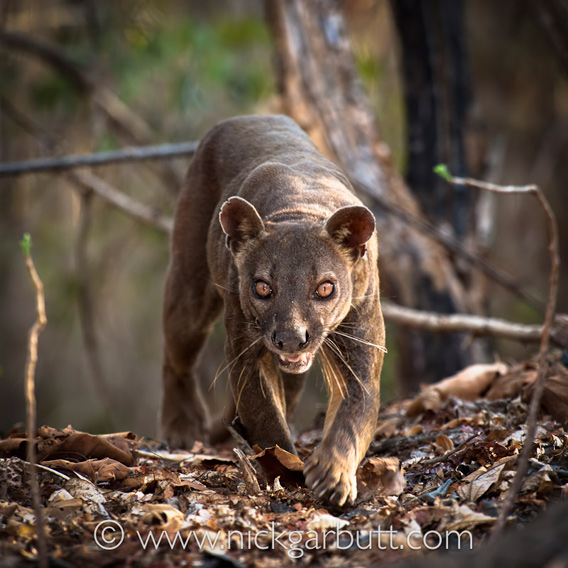
The Fossa (Cryptoprocta ferox)
Description
The Fossa is one of the most unusual but beautiful carnivores I have had the pleasure to see. It is a striking example of evolution and adaptation due to isolation and prey selection. It is the largest carnivore on Madagascar, the island which it is endemic to. It is a large cat-like carnivore belonging to the family Eupleridae, a family which is closely related to the mongoose family (Herpestidae). The classification of the fossa has been controversial mainly due to its physical traits which resemble those of cats. It was first classified as a cat but other studies rejected this changing its classification to that of the civets due to separate traits. It was once more classified as a cat before its final classification was determined through the use of genetic studies. Its final placement was that of Eupleridae alongside all other Malagasy carnivores as a branch off the the mongoose family.
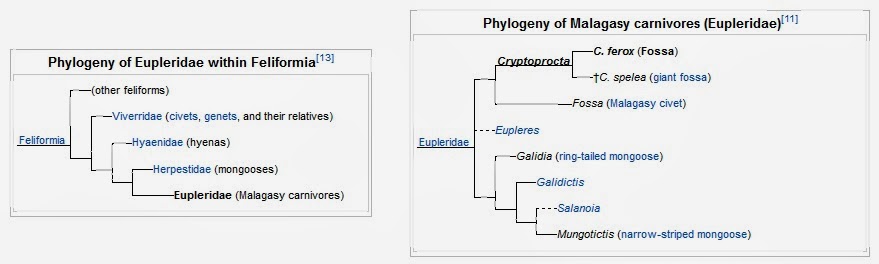 |
| Phylogeny of the Fossa (taken from en.wikipedia.org) |
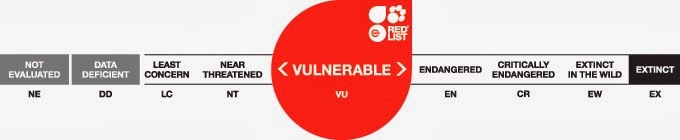
Adult fossa have a head-body length of 70-80 cm with a tail nearly matching the body length at around 65-70 cm. They weigh between 5.5-8.6 kg and males are typically larger than females. IUCN classifies the fossa as vulnerable under its species red list.
 |
| IUCN classification of the fossa |
The fossa has a reddish-brown short coat. It has a slender, muscular body with a fairly small head featuring a short muzzle and prominent ears. Many of the fossas adaptations have evolved to aide it climbing through trees. It uses its long tail for balance, and has semiplantigrade feet, meaning it can switch between plantigrade (walking on soles) when arboreal and digitigrade (walking on digits) when terrestrial. The soles of its paws are nearly bare, only covered with strong pads, the feed have semi-retractable claws and flexible ankles which allow it to efficiently climb up and down trees head first; they also support it as it jumps from tree to tree. However, the fossa's most unique trait within its family is that the shape of its genitalia share various traits with those of cats and hyenas rather than mongoose.
 |
| Fossa head (Copyright Sparrowhawk photography... me!) |
 |
| Fossa in tree (Copyright Nick Garbutt) |
 |
| Copyright Nick Garbutt |
 |
| Flexible ankles (Copyright Frans Lanting) |
Biology
The fossa is active during the day and night, apart from their breeding season they are generally solitary. Both the male and female occupy territory which is scent marked. The territories themselves vary in size depending on the abundance of prey species in the area. It feeds on a wide variety of small mammals, birds and reptiles. In higher mountainous areas small mammals such as the tenrec is a main feature of their diet whereas in the forests lemurs can make up more than 50% of prey items. The fossas long tail and adapted legs allow it to balance and pursue agile prey through the trees to great effect; it has also been noted that pairs may exhibit cooperative hunting strategies in order to take down larger prey. During a cooperative hunt one member will scale a tree and chase the lemurs from tree to tree, forcing them down to the ground where the other member can easily capture and kill them. Several studies have determined that the fossa hunts in a subsection of its territory until prey density decreases, then it moves on to another section. The wide variety of prey items that can be taken in various habitats is important for the fossa, its dietary flexibility & flexible activity patterns mean it can exploit a wide variety of niches available across the island, making it an essential key species for the Madagascar ecosystems.
 |
| The fossas jaws (Copyright Nick Garbutt) |
 |
| Fossa copulation |
Fossas have an unusual mating system, a receptive female will occupy a single tree below which anything up to eight males will congregate, fighting and calling to the female to gain her attention. Over a period of a week the female will mate with a number of different male suitors, with copulation bouts lasting anything up to 2.5 hours. A new female will then arrive and replace the original and the process begins again. This mating strategy where the female monopolizes a site and maximizes the number of mates is unique among carnivores. Recent studies have suggested that this mating system helps the fossa overcome factors which would normally impede mate-finding, such as low population density. These studies have also determined that the females mate selection is not related to the visual quality of a male. The mating season runs from September to November and 2 to 4 young are born in a concealed location such as an underground den, rock crevice or in the hollow of a large tree 3 months after copulation. The young are initially blind and helpless, only opening their eyes after 15 days. They remain with their mother (who raises them independently) until they are 15-20 months old.
Range and Habitat
The fossa is endemic to the island of Madagascar and is widespread throughout the island. However, in the central highlands it is only known to occupy certain areas such as the Andringitra Massif. It inhabits the majority of Malagasy forest types, up to elevations of around 2000 metres above sea level.
 |
| Distribution of the fossa |
Threats and Conservation
Recent surveys carried out on Madagascar have revealed that the fossa population is less than 2500 individuals. Habitat loss is one of the main causes of decline; fragmented populations become isolated in remaining forest patches preventing gene flow. However, the most serious threat to their survival comes from local farmers who regard fossa as serious predators to livestock and poultry. the fossa is now protected in a number of the islands reserves and national parks. A successful breeding programme has also been established on the island, along with numerous local education and awareness programmes. It is hoped that these measures already in place will be enough to secure its future however, they are still not protected under national legislation due to the conflict of interest.
These animals are truly fascinating creatures, although I've seen them in captivity I hope one day I will get the chance to see them in the wild. I'm just going to finish off this weeks feature with a few more of Nick Garbutt's photos of the fossa as they are truly stunning photographs!
 |
| Copyright Nick Garbutt |
 |
| Copyright Nick Garbutt |
 |
| Copyright Nick Garbutt |
None of the above images belong to me and all rights reserved to the
original photographer. I do try and find the original source for as many
of the photos as possible so I can give credit as I use them, but
that's not always possible.
Birdman.