Showing posts with label penguin. Show all posts

Monday, 10 February 2014

Striated Caracara = AotW

Striated Caracara (Phalcoboenus australis)
Striated caracara (Copyright me!)
 

Description

I thought this week I would move the focus back onto a bird (I promise I won't do birds all the time!) but this interesting, charismatic raptor is the focus of my dissertation project making it relevent. I can't imagine this being a large entry like the last few weeks as there is an awful lot about this birds ecology that we do not know or understand (hence me wanting to do a study on them), but I will make it as substantial as I can. The striated caracara is a bird of prey that belongs to the Falconidae family and like other caracara species they fall under the subfamily of Polyborinae. It is alternatively named Forster's caracara or the Johnny Rook. It has the southernmost overall breeding distribution of any bird of prey in the world. IUCN classifies them as Near Threatened due to their relativity low population. The striated caracara is a large and stocky raptor measuring at around 58-65 cm, although this species is sexually dimorphic with the female being on average 3% larger than the male.
IUCN classification of striated caracara

The striated caracara's plumage is mostly deep brown to black, with fine white streaks running through the feathers beginning at the nape of the neck which become broader and more conspicuous on the upper back and breast. The underwing plumage is more red-brown with white tips on the primary feathers; the tail ends in a whitish band. The birds has a bare yellow patch of skin around the eyes and base of the beak, which is bluish. This bare patch provides a striking contrast with the rest of the dark plumage. Immature birds are browner in colour and lack the distinctive streaking and tail band, but they possess a tawny patch of feathers on the upper back. Adult plumage is acquired when the bird is around 5 years old.

Adult striated caracara (Copyright Simon Bussey)
Juvenile striated caracara (Copyright me!)
In flight (Copyright Laurent Demongin)
Copyright Nitsch (DeviantART)


Biology

Feeding on Upland Goose chick (Copyright Laurent Demongin)
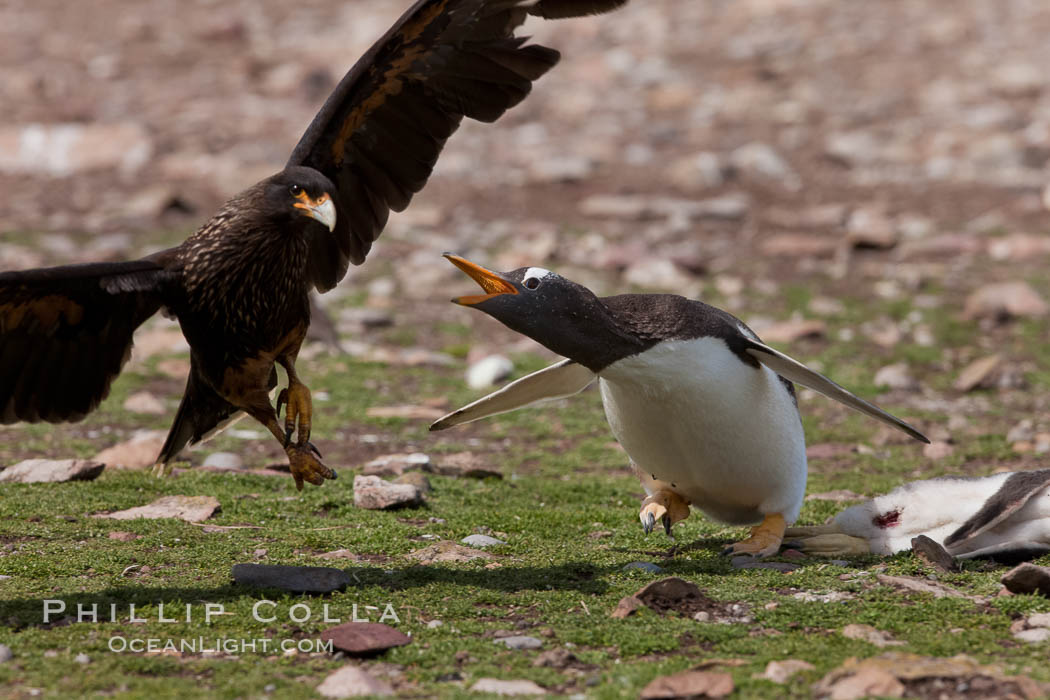
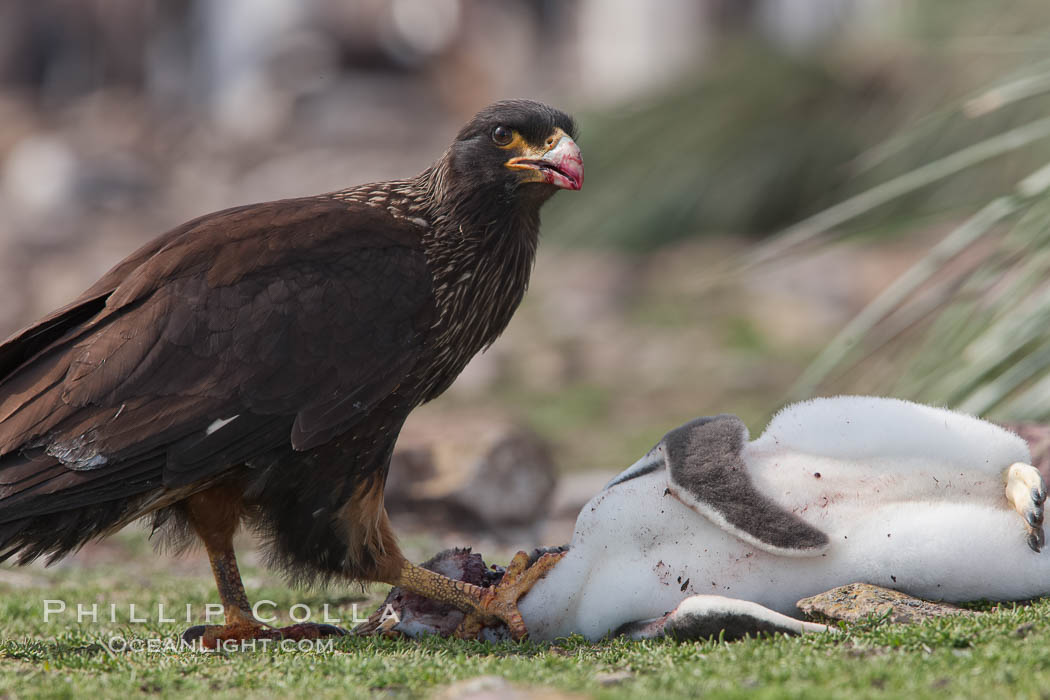
The striated caracara is naturally a tame, inquisitive bird with very opportunistic feeding habits. Their curiosity is thought to be more than a behavoural quirk, it serves an evolutionary purpose by aiding them in exploiting and developing novel ways of obtaining food, for example, they will dig small seabirds out of their burrows where they reside during the day and also hunt them on the wing at night. They spend the majority of their time on the ground by can run and fly swiftly if necessary. In most instances they use their strong feet to overturn large rocks and branches to search for food alongside digging. The diet of the striated caracara is variable, they will eat invertebrates, small seabirds, the eggs of larger seabirds such as penguins and albatross, dead, dying or young rockhopper penguins, which are a favoured food item, and the carcasses of furseals among other things including garbage. Where livestock and farming occurs across their range, they have been bought into conflict with humans as they are also prone to attack weak or stranded sheep. These birds also have a nefarious reputation for stealing red objects, including clothes and handkerchiefs. Like other falconiformes they have unparalleled colour vision which surpasses that of any mammal. Their innovative hunting methods have placed them as one of the most intelligent birds of prey. This bird of prey is also known to be cantankerous and will force other scavengers to relinquish their carrion.

Penguins worst nightmare (Copyright Phillip Colla)
With Gentoo penguin chick (Copyright Phillip Colla)
 
Gang of caracara feed on imperial shag (Copyright Laurent Demongin)

 The breeding season of this raptor occurs from December to late February, the female will lay a clutch of up to 4 eggs in a nest constructed from twigs and vegetation, lined with wool and grass. Hatching of the eggs is timed to match that of the nesting season of seabirds, thus providing a constant food supply for the chicks as they grow. After fledging young birds with often gather into large flocks which roam the islands. They are often solitary or in pairs but groups of up to 25 birds have been known to congregate in areas where a food source has become abundant.

In nest with chicks (Copyright Krystyna Szulecka)


Range and Habitat

The striated caracara is found on isolated shores off extreme south Argentina and Chile, including the south and east coasts of Isla Grande on Tierra del Fuego, Isla de los Estados, Navarino, Cape Horn and the Falkland Islands. It commonly inhabits open lowland areas, mainly along rocky coastlines, but also potentially appears at higher elevations on low coastal mountains. This bird is only found on islands where there is a population of seals or seabirds.
Distribution of striated caracara


Threats and Conservation

This bird of prey has been the victim of heavy, sustained and merciless persecution due to being tarred with an over harsh reputation of killing sheep. This caused its numbers to fall drastically across its range. Alongside human factors, the drastic decline of native seabird and seal populations are thought to have contributed to the caracara's falling numbers. From 1983 to 1992 it is believed that the population fell to between 500 and 600 pairs. In 2013 it is thought that the population has stabilized with them currently facing no immediate major threats. The population currently sits between 1500 and 4000 individuals. The striated caracara is now officially protected by Falkland law, making it illegal to kill this species without written permission from the Falkland Islands government. Some birds were taken from the islands and bought over to the UK where they entered breeding programmes within zoos. A notable success story occurred on New Island, West Falklands. The management of the island as a private nature reserve, set up in 1972, allowed the striated caracara to re-colonise the island, with it now representing the largest, single breeding population of this species in its range.
Group of juveniles (Copyright Frans Lanting) Looks like a 90's rap album cover...

Copyright Laurent Demongin

None of the above images belong to me and all rights reserved to the original photographer. I do try and find the original source for as many of the photos as possible so I can give credit as I use them, but that's not always possible.

Birdman.

Monday, 20 January 2014

The Penguin = AotW


This is the first entry in a new weekly feature for the blog. Now normally it would be a single species but this has fallen perfectly as today is penguin awareness day! So this week I'll be doing a little piece on the penguin.

The Penguin 

 Although all penguins share common features they are all uniquely different, they occupy different types of coast, different regions and climates, they also have different lifestyles and make use of different resources, this is what gives them their individuality in the ecosystem.

 Penguins are a flightless group of birds, which belong to the family Spheniscidae. Across the world there are 17 species of penguin, all of which can be found in the southern hemisphere. In light of not being able to fly the penguin has evolved quite differently to a lot of other avian species, birds that fly need a skeleton which is as light as possible, whereas the penguin is much heavier and robust as a light skeleton is not advantageous, a light, hollow skeleton would mean the bird would need to use a considerable amount of energy to overcome their natural buoyancy, a denser skeleton gives them greater strength and reduced buoyancy.

The distribution of penguins in the Southern hemisphere


The penguins history is thought to lead back to 50 million years ago, giving them a relativity long evolutionary history, this explains some of their unique structural differences, such as flippers (instead of wings) and a modified breast bone. despite this, many of the penguins alive today are very similar, they mostly have blackish upperparts and whitish underparts on the abdomen and flippers, acting as camouflage against the lighter sky when viewed from below and vice versa. Another unique adaptation are its interlocking feathers which act as barrier to water, each feather contains small muscles which allows them to be held tightly down against the birds body whilst it swims, acting as a sort of water proof layer. Not only this but it also means that little air is trapped within the plumage helping to further reduce buoyancy. In contrast, when on land these feathers are erect to do the opposite by trapping warm air to provide sufficient insulation. Fat deposits under the skin also provides insulation; a highly adapted vascular system is also present to maximize this. It works in such a way that heat loss can be greatly reduced from the extremities (flippers and feet) by keeping them as low as 6 Celsius despite a core body temperature of 39 Celsius, this reduces heat loss during winter and vice versa in summer months through a reversal of the system.

Penguins must retain their waterproof coating in their plumage, to do this they annually push out the old feathers and grow new ones during a molt. This requires a period of fasting by the penguin as they cannot reenter the water until their plumage has fully returned, and the water is where their entire food source is located. Incubation and brooding are also periods of fasting for penguins. During these phases they can greatly reduce their metabolic rate in order to reduce the rate at which fat reserves are used. To ensure the feathers keep their waterproofing, feathers are preened constantly with a waxy substance from a gland at the base of the tail. In areas that are inaccessible for self preening allopreening within the flock is seen, this is also part of their pair bonding behaviours. However, this is not seen in all penguin species

Whilst ungainly on land the penguin is a perfect aquatic predator in the water, they can reach speeds of up to 14km per hour for prolonged periods of time. They dive in search of prey and when located, they chase it and swallow it whole under the water, they have good all round vision and are able to alter the lens in their eye depending on if they are on land or in water, enaing they can compensate for the differing refractive indexes. The penguins eye is also more sensitive to greens and blues (due to hunting in the water). They eat fish, cephalopods and crustaceans as well as the occasional small stone to help break up food in the stomach. All penguins have the ability to dive to around 100m but larger species such as the king and emperor penguins have been recorded at around 500m. Healthy adult penguins have few natural predators on land, although on occasion Sea Lions have been known to take them on land. On land it is the eggs and chicks that are more at risk, Skuas and Gulls will often predate them, whereas in the water adults are prey to leopard seals, sea lions and orca. 

As a last note I will say that penguins are declining on a global scale. the main suspects are climate change, fisheries and disease and pollution. A greater understanding is needed of these great birds, in terms of their ecology and how they are affected by such threats. That is where days like today are great, in raising the awareness needed to help support the penguin.

(Information from a variety of sources including the International Penguin Conservation Work Group (IPCWG) go check out their website and their specific work in protecting this marvelous bird)
http://www.penguins.cl/index.htm

Species


1) Aptenodytes  - Great Penguins


  • King Penguin (Aptenodytes patagonicus)


  • Emperor Penguin (Aptenodytes forsteri)


2) Pygoscelis - Brush-tailed Penguins


  • Adelie Penguin (Pygoscelis adeliae)


  • Chinstrap Penguin (Pygoscelis antartica) 


  • Gentoo Penguin (Pygoscelis papua)


3) Eudyptula  - Little penguins


  • Little Blue Penguin (Eudyptula minor)


4) Spheniscus - Banded Penguin


  • Magellanic Penguin (Spheniscus magellanicus)


  • Humboldt Penguin (Spheniscus humboldt)


  •  Galapagos Penguin (Spheniscus mendiculus) 


  • African Penguin (Spheniscus demersus)


5) Megadyptes


  •  Yellow-eyed Penguin (Megadyptes antipodes)


6) Eudyptes - Crested Penguins


  • Fiordland Penguin (Eudyptes pachyrynchus)


  • Snares Penguin (Eudyptes robustus)


  •  Erect-crested Penguin (Eudyptes sclateri)


  • Western Rockhopper Penguin (Eudyptes chrysocome)
  • Eastern Rockhopper Penguin (Eudyptes filholi)
  • Northern Rockhopper Penguin (Eudyptes moseleyi)


  • Royal Penguin (Eudyptes schlegeli)


  • Macaroni Penguin (Eudyptes chrysolophus)


(Above list adapted from http://en.wikipedia.org)


*Disclaimer – I do not claim ownership for any of the above images, nor do they belong to me, they are copyrighted with all rights reserved to the original photographer*

Birdman.