Showing posts with label feature. Show all posts

Monday, 10 February 2014

Striated Caracara = AotW

Striated Caracara (Phalcoboenus australis)
Striated caracara (Copyright me!)
 

Description

I thought this week I would move the focus back onto a bird (I promise I won't do birds all the time!) but this interesting, charismatic raptor is the focus of my dissertation project making it relevent. I can't imagine this being a large entry like the last few weeks as there is an awful lot about this birds ecology that we do not know or understand (hence me wanting to do a study on them), but I will make it as substantial as I can. The striated caracara is a bird of prey that belongs to the Falconidae family and like other caracara species they fall under the subfamily of Polyborinae. It is alternatively named Forster's caracara or the Johnny Rook. It has the southernmost overall breeding distribution of any bird of prey in the world. IUCN classifies them as Near Threatened due to their relativity low population. The striated caracara is a large and stocky raptor measuring at around 58-65 cm, although this species is sexually dimorphic with the female being on average 3% larger than the male.
IUCN classification of striated caracara

The striated caracara's plumage is mostly deep brown to black, with fine white streaks running through the feathers beginning at the nape of the neck which become broader and more conspicuous on the upper back and breast. The underwing plumage is more red-brown with white tips on the primary feathers; the tail ends in a whitish band. The birds has a bare yellow patch of skin around the eyes and base of the beak, which is bluish. This bare patch provides a striking contrast with the rest of the dark plumage. Immature birds are browner in colour and lack the distinctive streaking and tail band, but they possess a tawny patch of feathers on the upper back. Adult plumage is acquired when the bird is around 5 years old.

Adult striated caracara (Copyright Simon Bussey)
Juvenile striated caracara (Copyright me!)
In flight (Copyright Laurent Demongin)
Copyright Nitsch (DeviantART)


Biology

Feeding on Upland Goose chick (Copyright Laurent Demongin)
The striated caracara is naturally a tame, inquisitive bird with very opportunistic feeding habits. Their curiosity is thought to be more than a behavoural quirk, it serves an evolutionary purpose by aiding them in exploiting and developing novel ways of obtaining food, for example, they will dig small seabirds out of their burrows where they reside during the day and also hunt them on the wing at night. They spend the majority of their time on the ground by can run and fly swiftly if necessary. In most instances they use their strong feet to overturn large rocks and branches to search for food alongside digging. The diet of the striated caracara is variable, they will eat invertebrates, small seabirds, the eggs of larger seabirds such as penguins and albatross, dead, dying or young rockhopper penguins, which are a favoured food item, and the carcasses of furseals among other things including garbage. Where livestock and farming occurs across their range, they have been bought into conflict with humans as they are also prone to attack weak or stranded sheep. These birds also have a nefarious reputation for stealing red objects, including clothes and handkerchiefs. Like other falconiformes they have unparalleled colour vision which surpasses that of any mammal. Their innovative hunting methods have placed them as one of the most intelligent birds of prey. This bird of prey is also known to be cantankerous and will force other scavengers to relinquish their carrion.

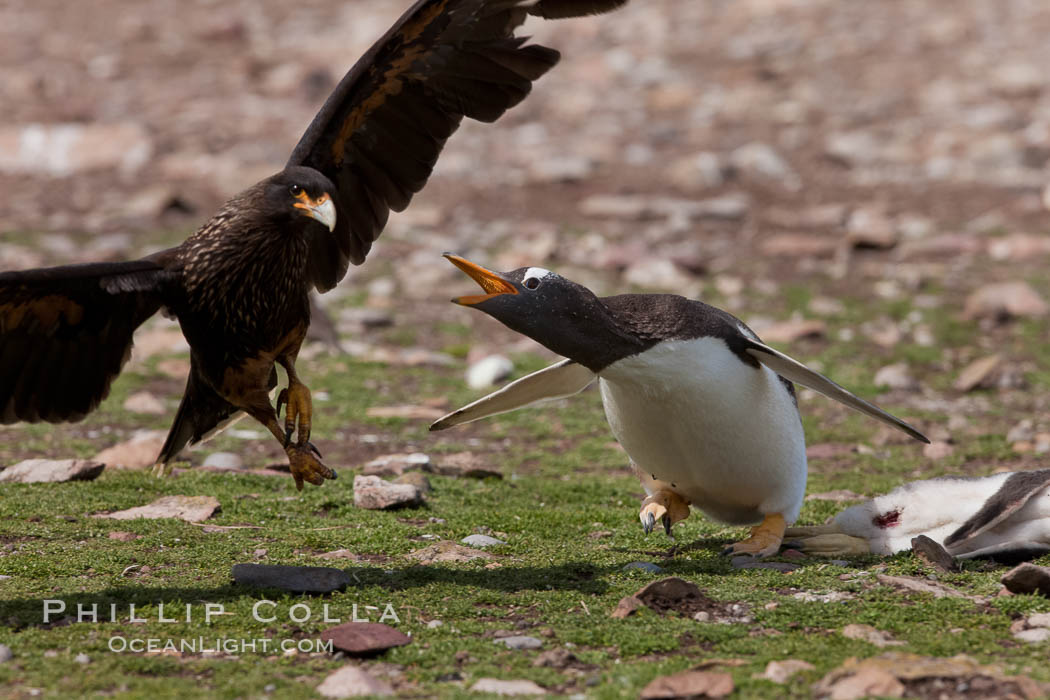
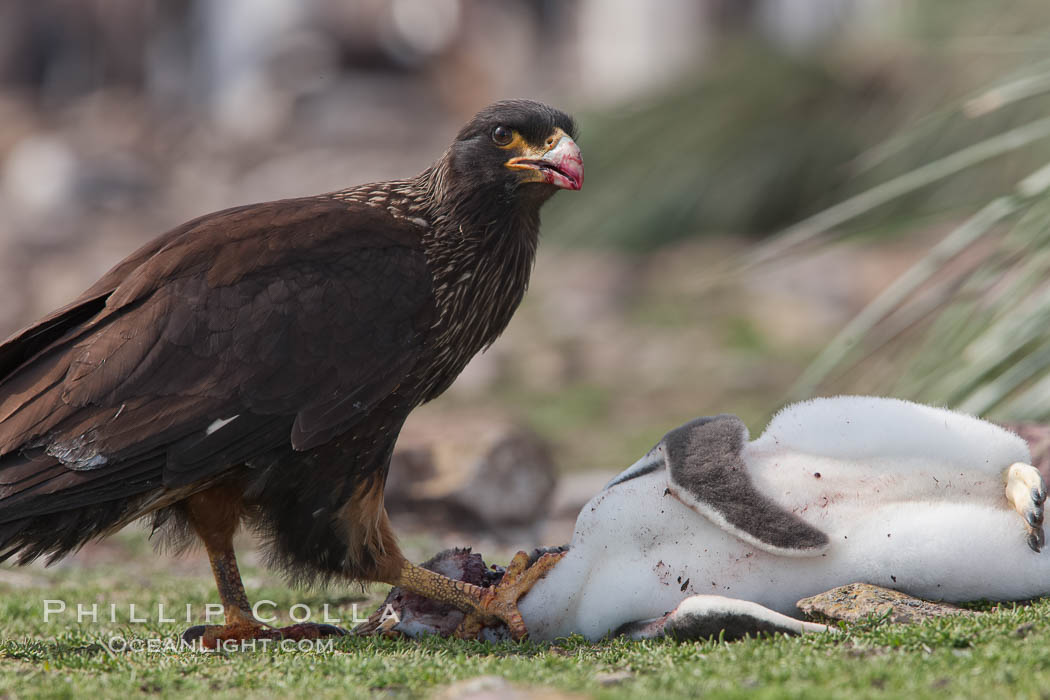
Penguins worst nightmare (Copyright Phillip Colla)
With Gentoo penguin chick (Copyright Phillip Colla)
 
Gang of caracara feed on imperial shag (Copyright Laurent Demongin)

 The breeding season of this raptor occurs from December to late February, the female will lay a clutch of up to 4 eggs in a nest constructed from twigs and vegetation, lined with wool and grass. Hatching of the eggs is timed to match that of the nesting season of seabirds, thus providing a constant food supply for the chicks as they grow. After fledging young birds with often gather into large flocks which roam the islands. They are often solitary or in pairs but groups of up to 25 birds have been known to congregate in areas where a food source has become abundant.

In nest with chicks (Copyright Krystyna Szulecka)


Range and Habitat

The striated caracara is found on isolated shores off extreme south Argentina and Chile, including the south and east coasts of Isla Grande on Tierra del Fuego, Isla de los Estados, Navarino, Cape Horn and the Falkland Islands. It commonly inhabits open lowland areas, mainly along rocky coastlines, but also potentially appears at higher elevations on low coastal mountains. This bird is only found on islands where there is a population of seals or seabirds.
Distribution of striated caracara


Threats and Conservation

This bird of prey has been the victim of heavy, sustained and merciless persecution due to being tarred with an over harsh reputation of killing sheep. This caused its numbers to fall drastically across its range. Alongside human factors, the drastic decline of native seabird and seal populations are thought to have contributed to the caracara's falling numbers. From 1983 to 1992 it is believed that the population fell to between 500 and 600 pairs. In 2013 it is thought that the population has stabilized with them currently facing no immediate major threats. The population currently sits between 1500 and 4000 individuals. The striated caracara is now officially protected by Falkland law, making it illegal to kill this species without written permission from the Falkland Islands government. Some birds were taken from the islands and bought over to the UK where they entered breeding programmes within zoos. A notable success story occurred on New Island, West Falklands. The management of the island as a private nature reserve, set up in 1972, allowed the striated caracara to re-colonise the island, with it now representing the largest, single breeding population of this species in its range.
Group of juveniles (Copyright Frans Lanting) Looks like a 90's rap album cover...

Copyright Laurent Demongin

None of the above images belong to me and all rights reserved to the original photographer. I do try and find the original source for as many of the photos as possible so I can give credit as I use them, but that's not always possible.

Birdman.

Monday, 3 February 2014

The Fossa = AotW

The Fossa (Cryptoprocta ferox)

Description


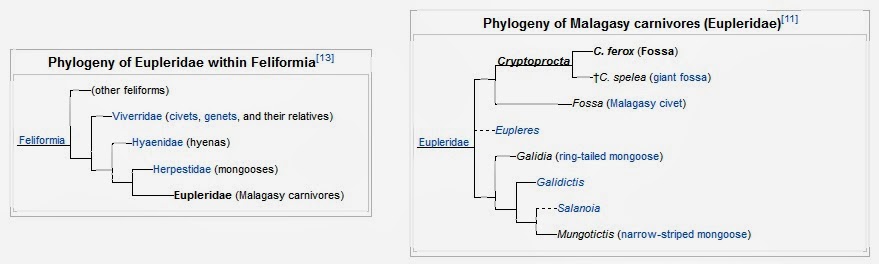
The Fossa is one of the most unusual but beautiful carnivores I have had the pleasure to see. It is a striking example of evolution and adaptation due to isolation and prey selection. It is the largest carnivore on Madagascar, the island which it is endemic to. It is a large cat-like carnivore belonging to the family Eupleridae, a family which is closely related to the mongoose family (Herpestidae). The classification of the fossa has been controversial mainly due to its physical traits which resemble those of cats. It was first classified as a cat but other studies rejected this changing its classification to that of the civets due to separate traits. It was once more classified as a cat before its final classification was determined through the use of genetic studies. Its final placement was that of Eupleridae alongside all other Malagasy carnivores as a branch off the the mongoose family.
Phylogeny of the Fossa (taken from en.wikipedia.org)

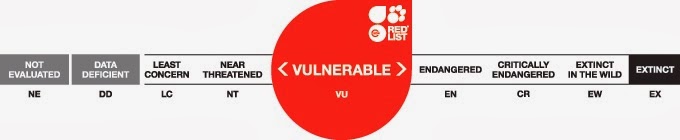
 Adult fossa have a head-body length of 70-80 cm with a tail nearly matching the body length at around 65-70 cm. They weigh between 5.5-8.6 kg and males are typically larger than females. IUCN classifies the fossa as vulnerable under its species red list.  
IUCN classification of the fossa

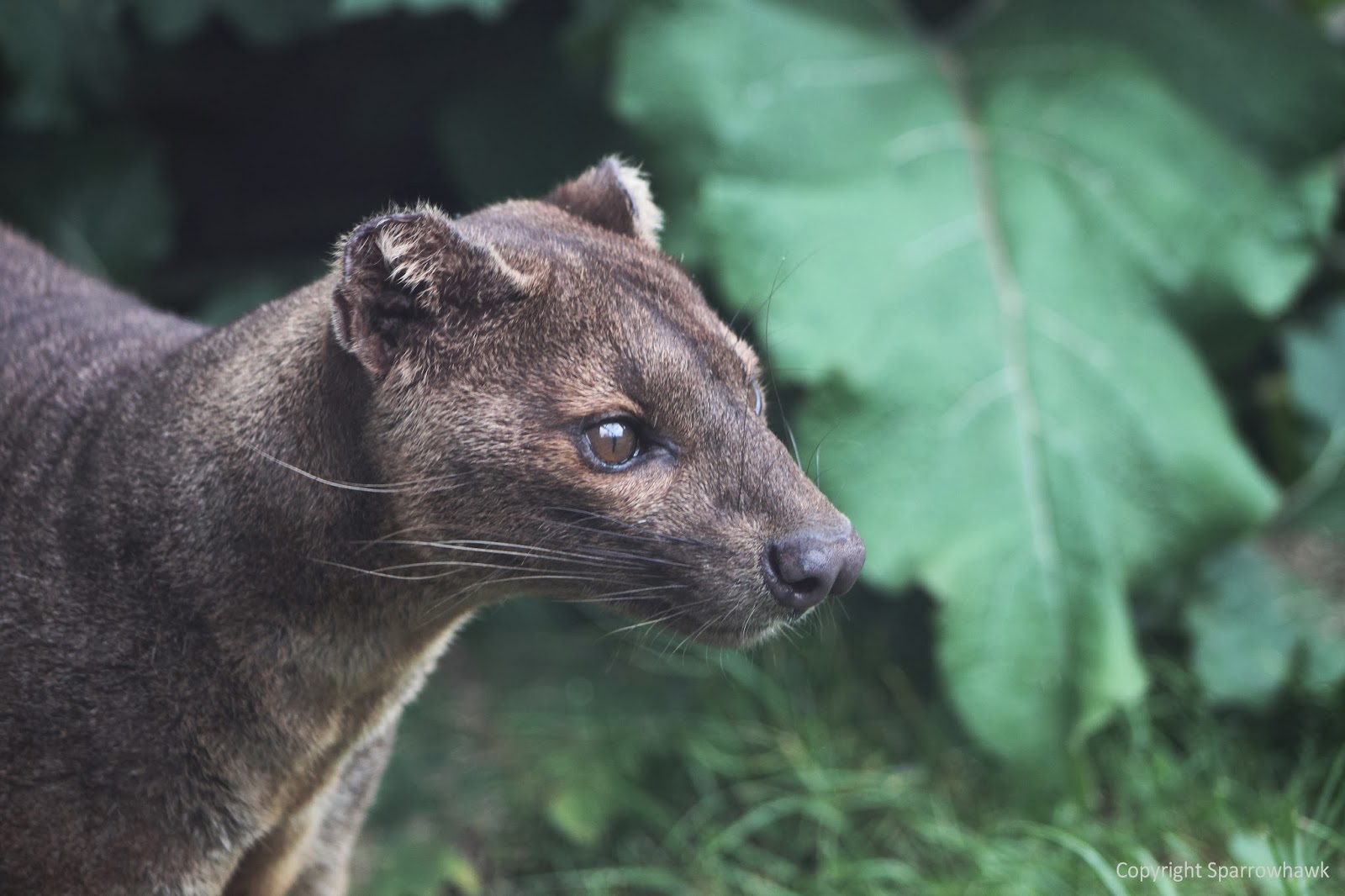
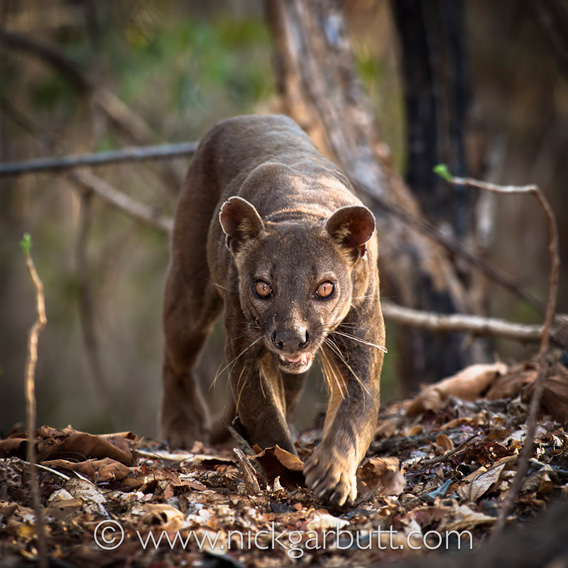
The fossa has a reddish-brown short coat. It has a slender, muscular body with a fairly small head featuring a short muzzle and prominent ears. Many of the fossas adaptations have evolved to aide it climbing through trees. It uses its long tail for balance, and has semiplantigrade feet, meaning it can switch between plantigrade (walking on soles) when arboreal and digitigrade (walking on digits) when terrestrial. The soles of its paws are nearly bare, only covered with strong pads, the feed have semi-retractable claws and flexible ankles which allow it to efficiently climb up and down trees head first; they also support it as it jumps from tree to tree. However, the fossa's most unique trait within its family is that the shape of its genitalia share various traits with those of cats and hyenas rather than mongoose.
Fossa head (Copyright Sparrowhawk photography... me!)
Fossa in tree (Copyright Nick Garbutt)
Copyright Nick Garbutt
Flexible ankles (Copyright Frans Lanting)

Biology 


The fossa is active during the day and night, apart from their breeding season they are generally solitary. Both the male and female occupy territory which is scent marked. The territories themselves vary in size depending on the abundance of prey species in the area. It feeds on a wide variety of small mammals, birds and reptiles. In higher mountainous areas small mammals such as the tenrec is a main feature of their diet whereas in the forests lemurs can make up more than 50% of prey items. The fossas long tail and adapted legs allow it to balance and pursue agile prey through the trees to great effect; it has also been noted that pairs may exhibit cooperative hunting strategies in order to take down larger prey. During a cooperative hunt one member will scale a tree and chase the lemurs from tree to tree, forcing them down to the ground where the other member can easily capture and kill them. Several studies have determined that the fossa hunts in a subsection of its territory until prey density decreases, then it moves on to another section. The wide variety of prey items that can be taken in various habitats is important for the fossa, its dietary flexibility & flexible activity patterns mean it can exploit a wide variety of niches available across the island, making it an essential key species for the Madagascar ecosystems.
 
The fossas jaws (Copyright Nick Garbutt)


Fossa copulation
Fossas have an unusual mating system, a receptive female will occupy a single tree below which anything up to eight males will congregate, fighting and calling to the female to gain her attention. Over a period of a week the female will mate with a number of different male suitors, with copulation bouts lasting anything up to 2.5 hours. A new female will then arrive and replace the original and the process begins again. This mating strategy where the female monopolizes a site and maximizes the number of mates is unique among carnivores. Recent studies have suggested that this mating system helps the fossa overcome factors which would normally impede mate-finding, such as low population density. These studies have also determined that the females mate selection is not related to the visual quality of a male. The mating season runs from September to November and 2 to 4 young are born in a concealed location such as an underground den, rock crevice or in the hollow of a large tree 3 months after copulation. The young are initially blind and helpless, only opening their eyes after 15 days. They remain with their mother (who raises them independently) until they are 15-20 months old.

 Range and Habitat


 The fossa is endemic to the island of Madagascar and is widespread throughout the island. However, in the central highlands it is only known to occupy certain areas such as the Andringitra Massif. It inhabits the majority of Malagasy forest types, up to elevations of around 2000 metres above sea level.
 
Distribution of the fossa

 Threats and Conservation


Recent surveys carried out on Madagascar have revealed that the fossa population is less than 2500 individuals. Habitat loss is one of the main causes of decline; fragmented populations become isolated in remaining forest patches preventing gene flow. However, the most serious threat to their survival comes from local farmers who regard fossa as serious predators to livestock and poultry. the fossa is now protected in a number of the islands reserves and national parks. A successful breeding programme has also been established on the island, along with numerous local education and awareness programmes. It is hoped that these measures already in place will be enough to secure its future however, they are still not protected under national legislation due to the conflict of interest.  

These animals are truly fascinating creatures, although I've seen them in captivity I hope one day I will get the chance to see them in the wild. I'm just going to finish off this weeks feature with a few more of Nick Garbutt's photos of the fossa as they are truly stunning photographs! 

Copyright Nick Garbutt

Copyright Nick Garbutt

None of the above images belong to me and all rights reserved to the original photographer. I do try and find the original source for as many of the photos as possible so I can give credit as I use them, but that's not always possible.

Birdman.

Monday, 27 January 2014

The Philippine Eagle = AotW

The Philippine Eagle (Pithecophaga jefferyi)

Description


What better way to properly start off this feature then by introducing my overall favorite animal.
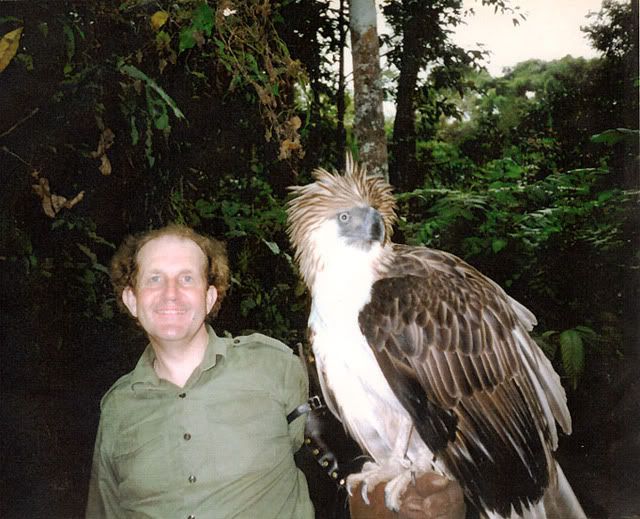
The Philippine eagle is also known as the monkey-eating eagle; it is the worlds largest eagle measuring at 86 - 102cm in length with a 2m wingspan. It weighs between 4.7 - 8.0 kilograms, meaning that although it is the largest in terms of length it is not in regard to weight and bulk with is being surpassed only by the Steller's sea eagle and Harpy eagle. Although it is the largest and one of the most powerful raptors it is also listed as one of the most endangered. IUCN classifies the species as one of the most critically endangered vertebrates on the planet.
IUCN classification of Philippine Eagle


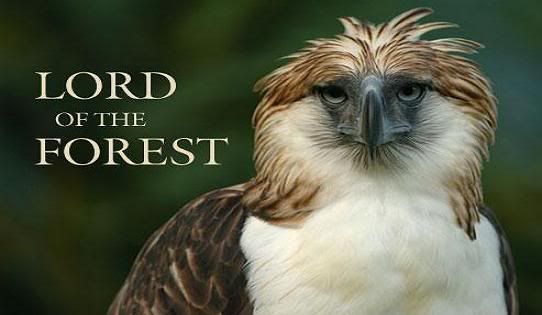
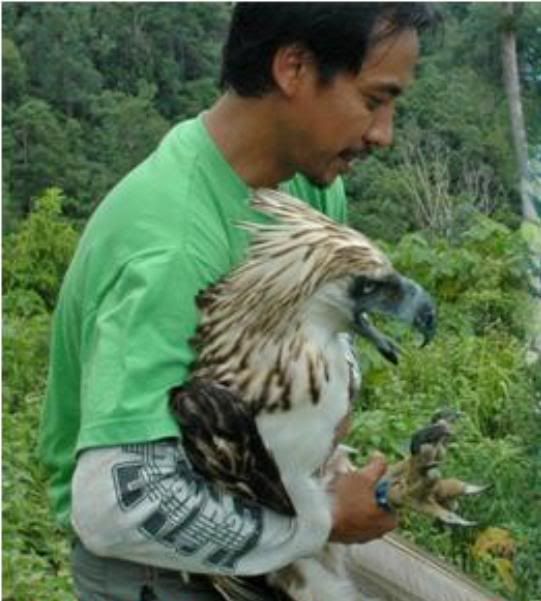
The Philippine eagle's nape is adorned with long, brown feathers that form a shaggy crest. These feathers give it an appearance of possessing a lion's mane, possibly explaining why it is often called "habiron" meaning "king bird". It has a dark face and a creamy brown nape and crown. The top of the bird is dark brown whilst its underside and underwings are white . It has large, heavy yellow legs each containing large, dark powerful talons, the deep beak of the Philippine eagle is a bluish grey, similar to its eye colour. The plumage of the juveniles are similar to the adults except their underparts have pale fringes.

Klaus Nigge - National Geographic (2008)
Philippine eagle foundation
 
Eagle flying - Craig Steely

Size comparison against a human

Biology

The Philippine eagle can live for up to 60 years. They feed primarily on flying lemurs (90% of its diet), palm civets and monkeys, other prey items include rats, bats, snakes, flying squirrels and birds. They utilize 2 main hunting strategies. The first is still-hunting where the bird watches for its prey activity whilst sitting motionlessly on a branch near the canopy. The second strategy is perch-hunting, the eagle will gradually work its way down from the canopy by gliding from perch to perch looking for food. if unsuccessful the fly or circle back up to the top of the trees and work them again. 
Catching a monkey

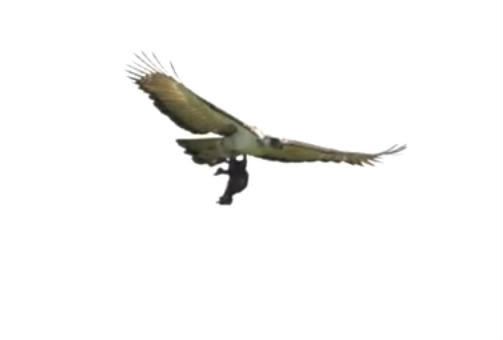
Philippine eagle with prey
It has also been found that pairs of Philippine eagles will hunt troops of monkeys (typically the local macaque species) cooperatively. One bird perches near the troop acting as a decoy to distract them which allows the partner to swoop in from the rear and seize a monkey through the element of surprise. This method is particularly desired when hunting monkeys as the macaques are around the same size as the eagle.

The Philippine eagle is monogamous and they build their nests high up in the canopy at around 30m. The territory of a single pair can span 133 sq Km (51 sq m). They lay a single egg between October and December. Females sexually mature at 5 and the males at 7.  Nest building signals the beginning of courtship. Aerial displays play a large role in their courtship, they include paired soaring over nesting territory, the male chasing the female in a diagonal dive, and mutual talon presentation. The single egg is incubated for 62 days with both sexes participating in incubation, both sexes also help feed the eaglet. The eaglet itself fledges after 4 or 5 months and both parents take care of the chick for a total of 20 months.

Range and habitat

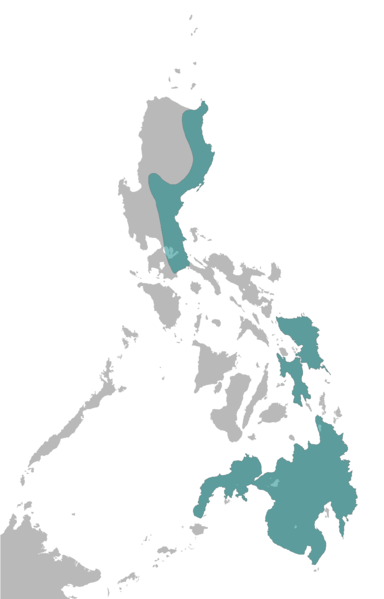
This eagle is endemic to the Philippines, and can be found on selective parts of the islands of Luzon, Samar, Leyte and Mindanao. It was once widespread but today there is only thought to be less than 250 mature birds. Populations are very small and as of 2013 the Philippine eagles numbers were still thought to be decreasing in the wild. It inhabits remnant patches of primary dipterocarp forest.
The distribution of the Philippine eagle in blue-green

Threats and conservation

The decline of the Philippine eagle has been a direct result of habitat destruction and fragmentation, through commercial timber extraction and shifting cultivation. Forest continues to be lost rapidly, it is believed that as little as 9220 sq km may remain within the eagles range. In the short term, hunting has been the most significant threat, juveniles are easy to shoot and trap and adult birds may also accidentally get caught in traps, intended for pigs and deer, whilst hunting on the forest floor. The killing of a Philippine eagle is punishable by 12 years in jail and heavy fines.

Philippine eagle being caught
The falling numbers of the eagle was first bought to international attention in 1965 by the Filipino ornithologist Dioscoro S. Rabor and the director of the Parks & Wildlife Office, Jesus A. Alverez. The Monkey-eating Eagle Conservation Program was started in 1969. However, it was not until 1992 the first chicks were born in captivity, through artificial insemination. The first natural birth in captivity came in 1999. Successive releases in the early 21st century were unsuccessful with the bird being killed. Its numbers have continued to dwindle since then. The Philippine Eagle foundation of Davao City, Mindanao is the main organisation dedicated to the protection and conservation of the eagle and its habitat. They have successfully bred Philippine eagles in captivity for the last decade and conducted the first experimental release to the wild. The centre currently houses 35 birds (18 of which are captive bred). Ongoing research on behaviour, ecology and population dynamics is also underway including the setting up of protected lands specifically for this species. The Philippine eagle has also  become a flagship species of the Philippines and was declared the national bird of the Philippines by president Fidel V. Ramos in 1995. 

 In all seriousness this is one of the most marvelous creatures left on the planet. if habitat destruction continues it is unlikely that this species will ever recover. Below I'll post the link to the Philippine Eagle Foundation (PEF) website so you can all take a look at their work. This is a bird I would love to go out and work with in the future.

Website: http://www.philippineeagle.org/index?pageval=thepef
Facebook: https://www.facebook.com/pages/Philippine-Eagle-Foundation-Official/149246185148978


Again none of the above images belong to me and all rights reserved to the original photographer. I do try and find the original source for as many of the photos as possible so I can give credit as I use them, but that's easier said then done.

Birdman.