Showing posts with label mammal. Show all posts

Wednesday, 21 May 2014

AoTW: The Probable Plight of the Pangolin


This is the last backdated post I am going to do and it is from even further back than the last entry. This was a post that I meant to do on February 15th to coincide with World Pangolin Day but other things got in the way. I find the pangolin to be a most fascinating mammal so they are going to be my animal of the week anyway, as their plight is something that people should know about. There are 8 species of pangolin in total but this entry will focus predominately on 2 of my favourite species.

The Pangolin

Pangolin's are burrowing mammals that eat predominantly ants and termites using a long, sticky tongue. They are covered in tough overlapping scales and can quickly roll up into a tight defensive ball when threatened earning them the name of "scaly anteaters". There are 8 different species that can be found across Asia and sub-Saharan Africa. Poaching for illegal wildlife trade and habitat loss have made these animals one of the most endangered groups of mammals in existence today. Before we begin looking at some of the species, take a look at a nice little info graphic below which gives some neat facts about the pangolin, courtesy of World Pangolin Day.

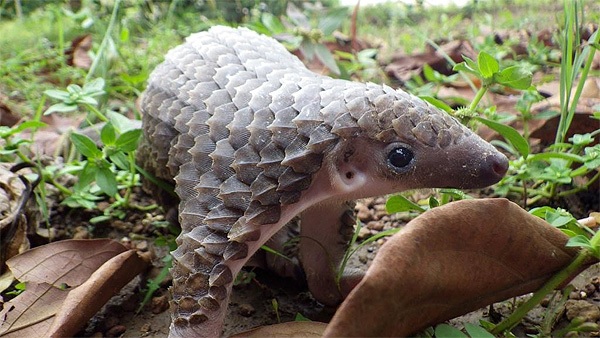
The pangolin's scales.
All pangolin species have a series of protective, overlapping scales that cover most of their bodies. The scales are formed for Keratin, the same protein that forms hair and nails. They overlap like artichoke leaves and grow throughout the pangolin's life just as hair does. The growth of scales is maintained by the animals burrowing ecology. The underside of the pangolin is not covered in scales, instead it is covered in sparse hair.

Tongue! - Copyright: Platyoctopie
Pangolin's also have conical heads and jaws which lack teeth , although they have long, muscular and sticky tongues which are perfectly designed to reach and lap up ant and termites deep within their nests. The tongue is attached near the pelvis of the animal and when fully extended is longer than the animals head and body. When at rest the tongue is retracted into a sheath within its chest cavity. Its stomach is muscular and lined in keratinous spines projecting outwards. Along with small stones, the stomach mashes and grinds prey as a replacement for having no teeth.As a defense against frenzied insects whilst feeding, along with armoured skin the pangolin can also close its nostrils, has armoured eyelids and some species even have internal ears which can also be closed to protect against bites and stings.

The limbs of a pangolin are stout and perfectly adapted for digging. Each paw has 5 toes and forefeet have 3 long, curved claws which are the main weaponry used to rip open ant and termite mounds.


Giant Ground Pangolin

 
Copyright: Nigel J. Dennis

Biology

The largest of the 8 species & the sole, remaining representatives of the highly specialised mammalian order Pholidota. In appearance and ecological purpose & function is is very similar to all other species and has poor eyesight but an acute sense of smell and very good hearing, despite the lack of external ears. The giant pangolin can reach sizes of up to 1.8 meters and despite its size, it is an elusive nocturnal species that spends the daytime under plant debris or out of sight in its burrow. During the night it goes in search of ant/termite mounds, once located, the pangolin rests on its broad heavy tail and uses its powerful claws to rip open the mound, using its long tongue to probe the cracks and tunnels for the insects within. 

Although normally solitary, males and females occasionally live together in the same burrow with their offspring. Little is known about the breeding biology of this pangolin although we do know that females carry the embryo for around 140 days before giving birth to a single young. The young pangolin will stay with the mother for the next 3-4 months and will accompany her on foraging bouts, riding on the base of the tail. 

Range & Habitat

The giant ground pangolin has a discontinuous range through West & Central Africa from Senegal to Ghana & Cameroon to Kenya. They inhabit predominately tropical lowland forest and forested swamps. 

Threats & Conservation

The ground pangolin is hunted for bush meat and persecuted for use in traditional medicine. Furthermore, some believe that the pangolin serves old ritualistic beliefs such as their scales being able to generate rain, neutralise evil spirits and ward off lions. Although concrete data on populations is not available, current research suggests that the population is declining gradually, leaving it classified as near threatened on the IUCN Red List.

Although populations of this species are present in 'protected' areas on African countries there are currently no specific targeted conservation measures in place for this species.

---------------------------------------------

Chinese Pangolin

 
Copyright: Unknown

Biology

The Chinese pangolin is covered in brownish scales, except for the soft, off-white underside and much of the face. The scales are made from fused hair and contribute up to 25% of the pangolin's total weight. When in danger, like other pangolin species, it rolls up into a defensive ball, leaving only the scaly parts of its body visible. their head is disproportionate with the rest of their body; they have small eyes, but unlike other pangolin's they have external ears.

The Chinese pangolin lives a solitary life and although terrestrial, it is capable of climbing trees and is a good swimmer. They often move slowly on all fours, walking on its knuckles due to its 5cm long claws on its forelegs. They have been occasionally seen walking on its hind legs, holding the body upright and the forelegs in the air; a similar position to the one it adopts when attacking termite mounds. They spend their day asleep in excavated burrows and emerge early evening to begin looking for food.

In late summer, male pangolin's are observed fighting over the opportunity to mate with a female, resulting in the victor and female mating over a period of 3-5 days. They spend the winter in deep burrows situated next to an active termite nest to provide a constant food source. It is during this period that females give birth to a single offspring. which emerges in Spring.

Range and Habitat

Wide distribution, being present in a variety of provinces across China, south of the Yangtze river, as well as in Taiwan, Hong Kong, Northern India, Vietnam, Nepal and Bangladesh. It lives in a variety of habitats, including tropical, coniferous, evergreen and bamboo forests as well as grasslands.

Threats & Conservation

Due to its nocturnal and solitary nature, this pangolin is rarely observed, so little information exists on its status, however, the population is thought to be declining and IUCN lists it as endangered. It has been extensively hunted for meat as well as for skin, and scales which are used to scratch mosquito bites, due to their supposed antiseptic properties, or ground into a powder which is wrongly believed to cure skin diseases. Its terrestrial nature makes it easier to hunt, a factor which is the pangolin's biggest threat as disturbance of habitat has shown to not affect pangolin as long as their food supply is not disrupted.

The Chinese pangolin is legally protected in the majority of countries it inhabits, although large seizures of illegally caught pangolin's do occur, greater enforcement of laws and improved management of protected areas are required to prevent hunting.

---------------------------------------------
Pangolins are split into 2 main groups:

The Asian pangolins include:
  • Indian or thick-tailed pangolin (Manis crassicaudata) – Conservation status Near Threatened
  • Chinese or Formosan pangolin (Manis pentadactyla) – Endangered
  • Malayan or Sunda pangolin (Manis javanica) – Endangered
  • Palawan or Philippine pangolin (Manis culionensis) – Near Threatened
The African pangolins include:
  • Cape or Temminck’s ground pangolin (Manis temminckii)
  • Tree or African white-bellied pangolin (Phataginus tricuspis) – Near Threatened
  • Giant ground pangolin (Smutsia gigantea) – Near Threatened
  • Long-tailed or black-bellied pangolin (Uromanis tetradactyla)

For more information on pangolin's check out the Save Pangolin's Website


Birdman.

The Birdman Chronicles creates no claim or credit for images featured on this blog unless otherwise noted. All visual content is copyrighted to it's respectful owners and every effort is made to link back to original content or photographer/ named whenever possible. If you own rights to any of the images, and do not wish them to appear here, please contact me and they will be promptly removed. 

Monday, 19 May 2014

AoTW: Day of the Tapiridae

 World Tapir Day - 27th April

The first of my belated entries! On April 27th it was World Tapir Day. This is a day that is new to me, so I think its worthwhile advertising.

The primary purpose for the day is to raise awareness about the four tapir species. Tapirs inhabit Central & South America and South-East Asia & all 4 species are thought to be in decline. Estimations place the mountain tapir as going extinct within the next 20 years. The Baird's tapir is facing a similar threat in its home range with the Malayan tapir and Brazilian tapir facing threats from severe habitat destruction.

The tapir is a large herbivorous ungulate and are one of the first species to be affected by human encroachment into their territory and one of the last to return once habitat has regrown. Tapirs live in habitat that ranges from jungles and grasslands to swamps and cloud forests, each of which is threatened by human activity, either mining, deforestation, palm oil plantations or roads & settlements. The reason the decline of the tapir is one that should be acknowledged is that like many other animals, they are a vital cog in the ecosystem machines of where they live, they act as important seed dispersers and are one of the oldest surviving genera in the animal kingdom. Despite their importance it is startling how little recognition these animals receive despite their presumably charismatic appearance. The threat posed towards the tapir is symbolic of the wider threat to their habitats and their decline is indicative of the general health of the habitat. 

If you would like to read a bit more on the significance of the day and the sorts of projects and events that take place, check out their website or Facebook page.


Tapir Species


Mountain Tapir (Tapirus pinchaque)


The mountain tapir is a 'living fossil' and is the smallest of the 4 surviving species that represents the remnants of a lineage that evolved 55 million years ago. It has thick, woolly reddish-brown to black fur, with white tipped ears and a whitish band between the feet and hooves in some instances and white lips.


Copyright: Katherine Davis

Brazilian Tapir (Tapirus terristris)


This bristly coated tapir varies from dark brown to greyish-brown and has a dark underside and legs with lighter cheeks, throat and upper lips. Newborns have a dark brown coat with white spots and stripes which provide camouflage. A prominent erect mane sits on top of the crest and extends from the forehead to shoulders. This is much more pronounced than other tapir species making it look stockier in appearance.


Copyright: Animals World 2011-2014

Bairds Tapir (Tapirus bairdii)


Is the largest of the American tapirs and is the largest indigenous mammal in Central America. This tapir has changed little in body shape over the past 35 million years. Although it is thought the proboscis may be a more recent adaptation. It has a barrel shaped body and stocky legs. Adults have short dark hair and grey coloured skin, apart from pale grey-yellow cheeks and throat and white tipped ears.  
Copyright: Eric Kilby


Malayan Tapir (Tapirus indicus)


It has an unmistakable two-tone pattern distinguishes this tapir from others. It is the only old world tapir and is the largest of all 4 species, they possess a stocky black body with a prominent white 'saddle' over the back which extend down the sides and around the body. The disruptive colouration helps break up the body outline in shady and moonlit forests.


Copyright: Animalphotos.me

Birdman

The Birdman Chronicles creates no claim or credit for images featured on this blog unless otherwise noted. All visual content is copyrighted to it's respectful owners and every effort is made to link back to original content or photographer/ name whenever possible. If you own rights to any of the images, and do not wish them to appear here, please contact me and they will be promptly removed.

Monday, 3 February 2014

The Fossa = AotW

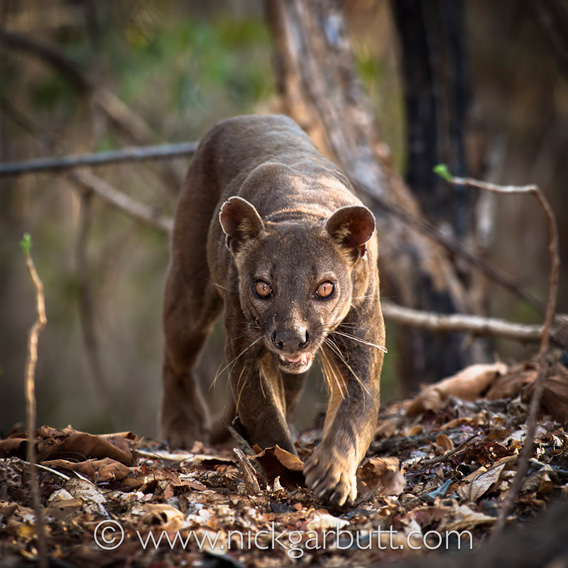
The Fossa (Cryptoprocta ferox)

Description


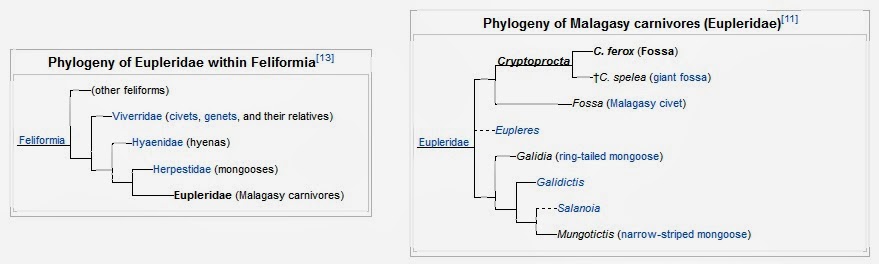
The Fossa is one of the most unusual but beautiful carnivores I have had the pleasure to see. It is a striking example of evolution and adaptation due to isolation and prey selection. It is the largest carnivore on Madagascar, the island which it is endemic to. It is a large cat-like carnivore belonging to the family Eupleridae, a family which is closely related to the mongoose family (Herpestidae). The classification of the fossa has been controversial mainly due to its physical traits which resemble those of cats. It was first classified as a cat but other studies rejected this changing its classification to that of the civets due to separate traits. It was once more classified as a cat before its final classification was determined through the use of genetic studies. Its final placement was that of Eupleridae alongside all other Malagasy carnivores as a branch off the the mongoose family.
Phylogeny of the Fossa (taken from en.wikipedia.org)

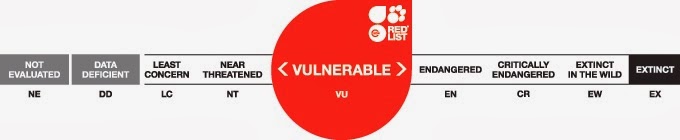
 Adult fossa have a head-body length of 70-80 cm with a tail nearly matching the body length at around 65-70 cm. They weigh between 5.5-8.6 kg and males are typically larger than females. IUCN classifies the fossa as vulnerable under its species red list.  
IUCN classification of the fossa

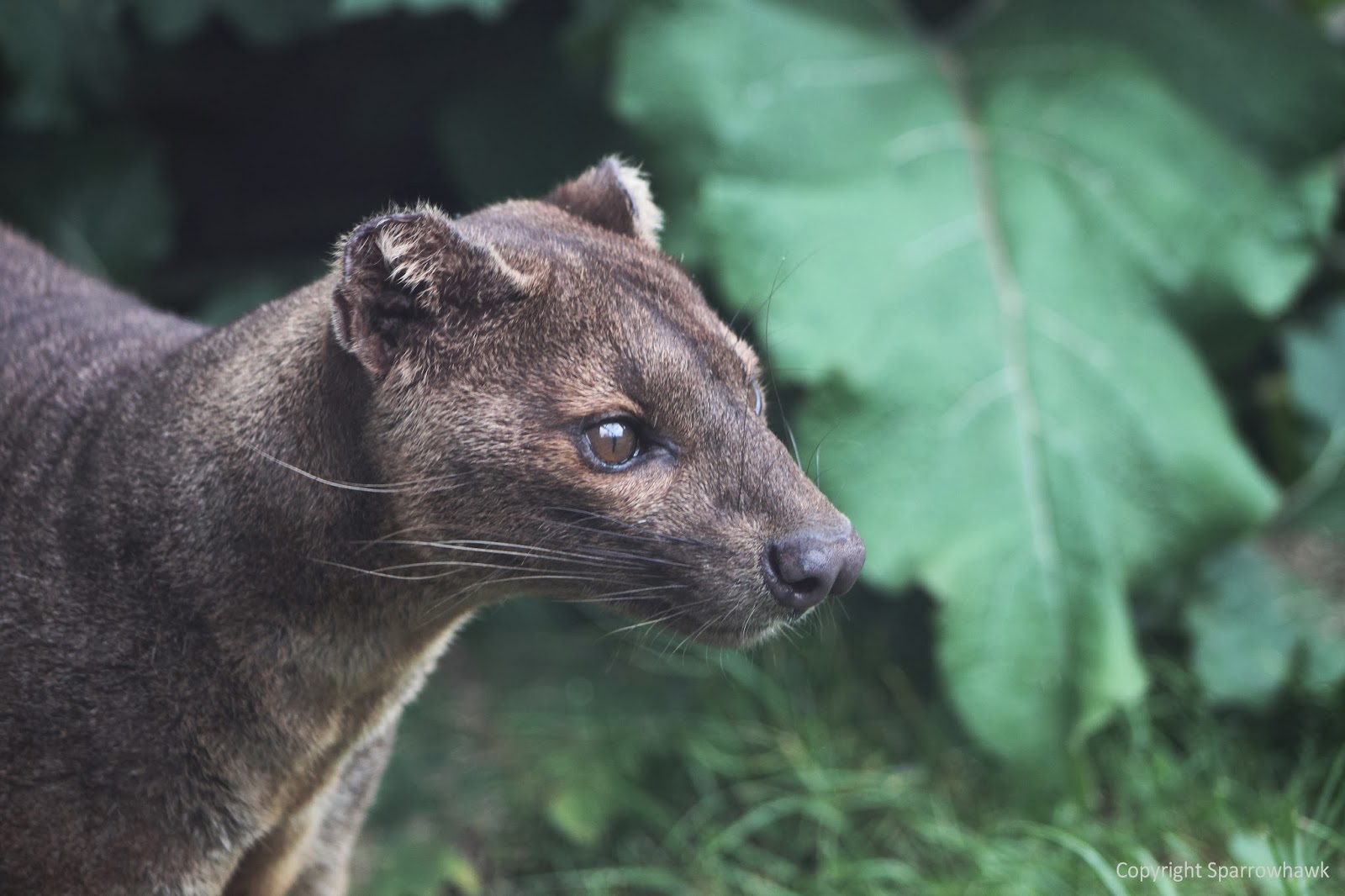
The fossa has a reddish-brown short coat. It has a slender, muscular body with a fairly small head featuring a short muzzle and prominent ears. Many of the fossas adaptations have evolved to aide it climbing through trees. It uses its long tail for balance, and has semiplantigrade feet, meaning it can switch between plantigrade (walking on soles) when arboreal and digitigrade (walking on digits) when terrestrial. The soles of its paws are nearly bare, only covered with strong pads, the feed have semi-retractable claws and flexible ankles which allow it to efficiently climb up and down trees head first; they also support it as it jumps from tree to tree. However, the fossa's most unique trait within its family is that the shape of its genitalia share various traits with those of cats and hyenas rather than mongoose.
Fossa head (Copyright Sparrowhawk photography... me!)
Fossa in tree (Copyright Nick Garbutt)
Copyright Nick Garbutt
Flexible ankles (Copyright Frans Lanting)

Biology 


The fossa is active during the day and night, apart from their breeding season they are generally solitary. Both the male and female occupy territory which is scent marked. The territories themselves vary in size depending on the abundance of prey species in the area. It feeds on a wide variety of small mammals, birds and reptiles. In higher mountainous areas small mammals such as the tenrec is a main feature of their diet whereas in the forests lemurs can make up more than 50% of prey items. The fossas long tail and adapted legs allow it to balance and pursue agile prey through the trees to great effect; it has also been noted that pairs may exhibit cooperative hunting strategies in order to take down larger prey. During a cooperative hunt one member will scale a tree and chase the lemurs from tree to tree, forcing them down to the ground where the other member can easily capture and kill them. Several studies have determined that the fossa hunts in a subsection of its territory until prey density decreases, then it moves on to another section. The wide variety of prey items that can be taken in various habitats is important for the fossa, its dietary flexibility & flexible activity patterns mean it can exploit a wide variety of niches available across the island, making it an essential key species for the Madagascar ecosystems.
 
The fossas jaws (Copyright Nick Garbutt)


Fossa copulation
Fossas have an unusual mating system, a receptive female will occupy a single tree below which anything up to eight males will congregate, fighting and calling to the female to gain her attention. Over a period of a week the female will mate with a number of different male suitors, with copulation bouts lasting anything up to 2.5 hours. A new female will then arrive and replace the original and the process begins again. This mating strategy where the female monopolizes a site and maximizes the number of mates is unique among carnivores. Recent studies have suggested that this mating system helps the fossa overcome factors which would normally impede mate-finding, such as low population density. These studies have also determined that the females mate selection is not related to the visual quality of a male. The mating season runs from September to November and 2 to 4 young are born in a concealed location such as an underground den, rock crevice or in the hollow of a large tree 3 months after copulation. The young are initially blind and helpless, only opening their eyes after 15 days. They remain with their mother (who raises them independently) until they are 15-20 months old.

 Range and Habitat


 The fossa is endemic to the island of Madagascar and is widespread throughout the island. However, in the central highlands it is only known to occupy certain areas such as the Andringitra Massif. It inhabits the majority of Malagasy forest types, up to elevations of around 2000 metres above sea level.
 
Distribution of the fossa

 Threats and Conservation


Recent surveys carried out on Madagascar have revealed that the fossa population is less than 2500 individuals. Habitat loss is one of the main causes of decline; fragmented populations become isolated in remaining forest patches preventing gene flow. However, the most serious threat to their survival comes from local farmers who regard fossa as serious predators to livestock and poultry. the fossa is now protected in a number of the islands reserves and national parks. A successful breeding programme has also been established on the island, along with numerous local education and awareness programmes. It is hoped that these measures already in place will be enough to secure its future however, they are still not protected under national legislation due to the conflict of interest.  

These animals are truly fascinating creatures, although I've seen them in captivity I hope one day I will get the chance to see them in the wild. I'm just going to finish off this weeks feature with a few more of Nick Garbutt's photos of the fossa as they are truly stunning photographs! 

Copyright Nick Garbutt

Copyright Nick Garbutt

None of the above images belong to me and all rights reserved to the original photographer. I do try and find the original source for as many of the photos as possible so I can give credit as I use them, but that's not always possible.

Birdman.

Wednesday, 29 January 2014

Surveying for Badgers - Restoring Force

Lord Brocktree
I grew up not only learning about badgers from my animal books but I read about them in a different capacity, through fiction I was enlightened. Throughout my childhood I read the Tales of Redwall books, written by the late Brian Jacques. It was a world where the majestic badger lords and ladies ruled the mountain kingdom of Salamandastron. They were the mightiest of warriors, the fairest rulers and the most respected of creatures. From Lord Brocktree to Lady Cregga Rose Eyes you could always rely on the badgers to protect their friends and dispatch their foe with unparallelled strength, along with The Long Patrol, their loyal army of Hares. These are the sorts of stories and tales which really captured my imagination, the stories they told were of a warriors code, destiny, duty, unity, friendship and villainy (some of them were really dark looking back on it) & subliminally they opened my eyes to the brilliant wildlife we can find in the United Kingdom. They resonate even today. Its safe to say I am very passionate about the badger, they rank highly and I, like many others do strive to help protect these creatures from the encroaching unjust, cruel and nonsensical threats poised against them by certain sectors of our society and government. Threats that are equally as poisonous and brutal without cause as some of the enemies I grew up reading about in the Redwall books.


Badger footprint
Peanut butter with red pellets
This reminiscing leads nicely into something our group at university has just started doing. We are helping to take part in some badger surveying around our universities estate. Its something I've always wanted to do, we have been told of the theory a million times but to actually go out and put some of the theory to use is superb! The setts had already been identified our role was to help with some bait marking surveys (not to be confused with the medieval badger baiting). First of all we walked around the areas of the setts identifying signs of presence, including footprints, snuffle holes and walkways. The next task was to find the latrines, these are originally snuffle holes in the ground which the badger then proceeds to use as a toilet, as a method of marking out their territory. Once we had found some (I never thought we'd be so happy to find poo) we could move onto the bait marking. This involved mixing a small amount of tiny (and I mean tiny, probably 2mm max) coloured plastic pellets in with a dollop of jam or peanut butter. We spaced these out around the setts ranges under heavy logs or stones. The reason for jam or peanut butter, well badgers like a lot of animals have an irresistible sweet tooth. Placing the bait under heavy logs or stones is also ideal as badgers are incredibly strong, with massive front paws. They will be easy for them to tip over to get to the bait whilst preventing other mammals such as foxes from getting to it. We used different coloured pellets for different setts. Once this was done it was time to retreat, the next stage begins tomorrow... early. We will have to revisit the latrines and look through the faeces (who said working with animals is glamorous). The pellets would have been digested and expelled as part of the faeces meaning that we can identify which coloured pellets are in which latrine, thus allowing us to mark out the territory for that particular sett (as they will leave some droppings in a number of latrines around the sett). It'll be a great way of helping us map out the local territories for our resident badgers, after all anything that can help us further understand them must be a good thing.
Snuffle holes

Badger pathway

The Results

Gearing up for action!
So the morning came and we were up bright an early to search the latrines, after a morning Starbucks to give us an energy boost we got walking to the setts. Due to the rain we were not expecting to get sterling results but that is the way of science! We went to sett after sett to no avail, we searched through the faeces but got no pellets. in with the faeces. After checking the latrines we searched the areas where we initially placed bait and got some interesting results. It turns out that in some instances the sweet jam or peanut butter had been devoured with a few pellets, but a large amount of the coloured pellets were left over and in other spots it hadn't been touched at all. It was a bit of a disappointment but still worthwhile, it gives us a chance to refine and evaluate. In all we have suggested that either too many pellets were used, making it look too conspicuous to the badgers hence they don't eat it, or it the ingested pellets haven't passed fully through their system yet. So the latrines will be checked again tomorrow to see if they have passed and more bait will be placed next week using less pellets which will be mixed more thoroughly with the jam and peanut butter.

Searching the latrines, as glamorous as it gets!

Jam gone, pellets remain

Round 2

Another week, another round of surveying. The pellets had been reset over the weekend and our group were in to check the latrines once more. Again it was a bit of a mixed week, in some places we found pellets in others, nothing. Its slightly frustrating but something you have to deal with, adapt and try again, after all this is a survey that overall could take years to get conclusive results from. Alongside searching latrines we did move the process further slightly. This week our main focus was classification of the setts, along with marking territory it is important that we understand which setts are which in a territory, whether they are the main sett, annexe setts subsidiary or outliers, this is vital information which becomes useful when mitigation arises, as it is more important to concentrate efforts on the main and annexe setts rather than outliers which are rarely used.
Latrine with faeces

Outlying sett


Unfortunately this was the last week we were out with the badgers, Time to leave it to the professionals. I know we could have stayed for the rest of the year working on this, i wouldn't have complained that's for sure, but our timetable says otherwise. We still have plenty of lectures that we can't afford to not have, as this conservation stream is the only part of the course I have an exam in this year.
So this ends my contribution with the wonder that is the badger, for now at least. I've thouroughly enjoyed it.


Birdman